
Can AI Replace Humans? Understanding the Future of Work
Artificial intelligence (AI) has changed the way people work, communicate, learn, and solve problems. From AI chatbots and virtual assistants to automated factories and intelligent software, artificial intelligence is becoming part of everyday life. This has led to an important question: Can AI replace humans?
The short answer is that AI can replace humans in some tasks and certain types of jobs, but completely replacing humans is much more complicated. AI is extremely powerful at processing information, recognizing patterns, generating content, and performing repetitive tasks. However, human beings bring creativity, emotional intelligence, ethical judgment, empathy, adaptability, and real-world understanding.
Instead of thinking about AI as simply replacing people, it may be more useful to consider how humans and AI can work together to create a more productive future.
How AI Is Changing the Workplace
AI is already transforming workplaces across different industries. Businesses use AI to automate repetitive processes, analyze large amounts of data, improve customer service, and make faster decisions.
For example, companies can use AI-powered systems to analyze sales data within seconds. Customer-support businesses can use AI chatbots to answer common questions. Software developers can use AI coding assistants to generate or review code.
This does not necessarily mean that every employee will lose their job. In many situations, AI changes the tasks people perform rather than eliminating an entire profession.
The growing use of AI automation means that workers may need to learn new skills and adapt to changing responsibilities.
What Jobs Can AI Replace?
AI is particularly effective at tasks that are repetitive, predictable, and based on large amounts of structured information.
Data Entry and Administrative Tasks
Data entry is one example of work that can be heavily automated. AI systems can extract information from documents, organize data, and enter information into databases.
Administrative tools can also automate scheduling, basic document processing, and routine communication.
Customer Service
AI chatbots can handle many basic customer-service questions. They can provide information, help users find products, and solve simple problems without human intervention.
However, complicated complaints often require human employees who can understand emotions, negotiate solutions, and make decisions based on context.
Manufacturing
Factories have used automation for decades, and AI is making these systems more intelligent. Robots can perform repetitive manufacturing tasks with high consistency.
AI-powered systems can also identify defects, monitor equipment, and predict when machines may require maintenance.
Basic Content and Analysis
AI can generate summaries, simple reports, product descriptions, and other routine content. It can also analyze large datasets and identify patterns much faster than humans.
However, human review remains important when accuracy, originality, context, or judgment matters.
Jobs AI Cannot Easily Replace
Although AI has impressive capabilities, there are several areas where human skills in the AI era remain extremely important.
Creativity and Original Thinking
AI can generate text, images, music, and ideas, but human creativity involves more than producing content. Humans understand personal experiences, culture, emotions, and social context.
Artists, entrepreneurs, designers, writers, and innovators often create ideas based on experiences and perspectives that are difficult to reproduce through automated systems.
Emotional Intelligence
Empathy is another major human advantage.
Teachers, healthcare professionals, counselors, managers, and social workers frequently deal with people during emotional or difficult situations. These roles require understanding feelings, building trust, and responding appropriately.
AI can recognize certain emotional signals, but genuine human relationships involve much more than recognizing patterns.
Leadership and Decision-Making
Important decisions often involve uncertainty, competing interests, values, and ethical considerations.
A business leader may need to decide whether a particular strategy is fair to employees. A doctor may need to discuss treatment options with a patient. A teacher may need to understand why a student is struggling.
These situations require human judgment, not just data processing.
AI in Healthcare: Replacement or Assistance?
Healthcare provides a useful example of why the future may involve collaboration between humans and AI.
AI can help doctors analyze medical images, identify patterns in patient data, assist with research, and organize information. These capabilities can potentially improve efficiency and support medical professionals.
However, healthcare is not simply about identifying information. Doctors and nurses communicate with patients, understand their concerns, consider individual circumstances, and make decisions that can have serious consequences.
Therefore, AI is more likely to become a powerful healthcare assistant rather than completely replace healthcare professionals.
AI in Education
Education is another field experiencing significant AI-driven change.
AI can help students understand difficult topics, generate practice questions, provide feedback, and personalize learning materials. Teachers can also use AI to reduce repetitive administrative work.
However, education involves mentorship and human connection.
A teacher does more than deliver information. Teachers motivate students, understand their strengths and weaknesses, manage classroom relationships, and encourage personal development.
This means AI may support teachers without completely replacing them.
AI vs Human Intelligence: What’s the Difference?
The debate about AI vs human intelligence often focuses on which one is more powerful. However, AI and human intelligence work differently.
AI can process enormous quantities of information quickly and identify patterns across large datasets. It does not get tired in the same way humans do and can perform repetitive calculations efficiently.
Humans, on the other hand, can learn from relatively small amounts of experience, understand complex social situations, develop relationships, and apply values and judgment to unfamiliar circumstances.
AI is therefore not simply a faster version of the human brain. It is a different type of technology with different strengths and limitations.
<h4>Why Human Skills Will Become More Valuable</h4>
As AI handles more repetitive tasks, skills that machines struggle to replicate may become increasingly valuable.
Some important skills include:
- Critical thinking
- Creativity
- Communication
- Leadership
- Empathy
- Problem-solving
- Collaboration
- Adaptability
- Ethical reasoning
- Emotional intelligence
Workers who understand how to use AI while developing these human abilities may have an advantage in the changing workplace.
<h5>Will AI Create New Jobs?</h5>
Technology has historically eliminated certain tasks while creating new types of work. AI is likely to follow a similar pattern.
As businesses adopt artificial intelligence, new roles may emerge around AI development, implementation, monitoring, security, data management, and responsible AI use.
Even existing professions may evolve. Marketing professionals may use AI for research. Designers may use AI for brainstorming. Developers may use AI coding tools. Teachers may use AI to personalize learning.
The important change may therefore be how people work, rather than simply how many jobs exist.
<h6>How Humans and AI Can Work Together</h6>
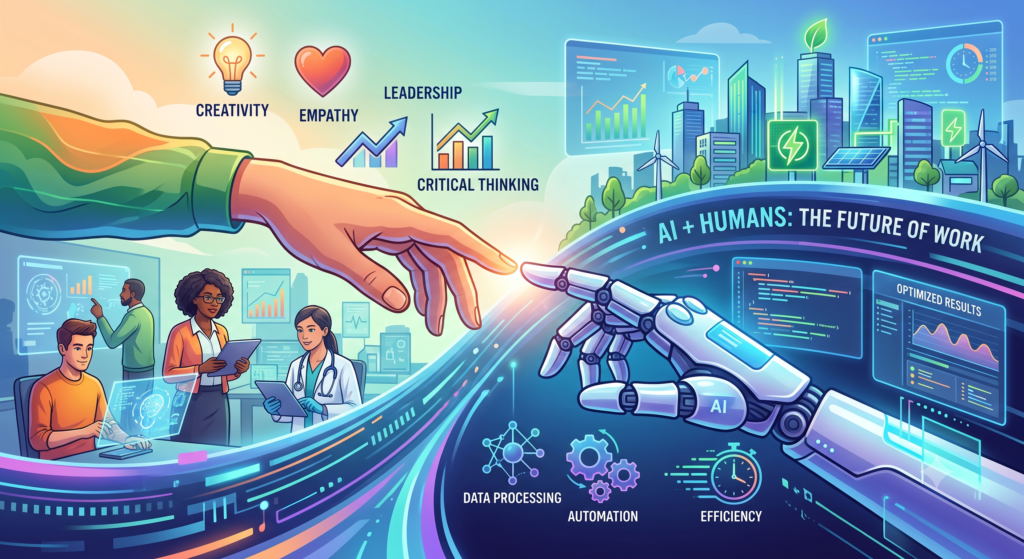
The most realistic future is likely to involve collaboration between humans and AI.
AI can handle repetitive tasks, process large datasets, identify patterns, and provide suggestions. Humans can provide creativity, context, empathy, ethical judgment, and accountability.
For example, an AI system might analyze thousands of customer reviews and identify common complaints. A human manager can then use those insights to decide what changes the company should make.
Similarly, AI can help a doctor identify patterns in medical data, while the doctor considers the patient’s individual circumstances and communicates the available options.
This combination can make work faster without removing the human element.
The Impact of AI on Employment
The impact of AI on employment will likely vary between industries and occupations. Some jobs may experience significant automation, while others may change gradually.
Workers whose responsibilities consist largely of repetitive tasks could face greater disruption. At the same time, employees who learn to work effectively with AI may find new opportunities.
Education and continuous learning will therefore become increasingly important. Instead of asking only whether AI will take jobs, individuals and organizations should also ask:
What skills will people need when AI becomes a normal part of work?
Final Thoughts: Can AI Replace Humans?
So, can AI replace humans? AI can certainly replace humans in some tasks, and it may reduce the need for people to perform certain repetitive jobs. But completely replacing humans across every industry is unlikely.
Human creativity, empathy, leadership, ethical reasoning, communication, and adaptability remain extremely valuable. AI is powerful, but it has limitations and depends on humans for goals, oversight, context, and responsible use.
The future of work is therefore unlikely to be simply humans versus AI. A more realistic future is humans with AI.
People who learn how to use artificial intelligence effectively while strengthening uniquely human skills will be better prepared for the changing workplace. Rather than seeing AI only as a replacement technology, we can view it as a tool that helps humans work smarter, solve complex problems, and focus more on the tasks that require human judgment and creativity.
The biggest question may not be “Will AI replace humans?” but rather “How can humans use AI to become more capable?”