
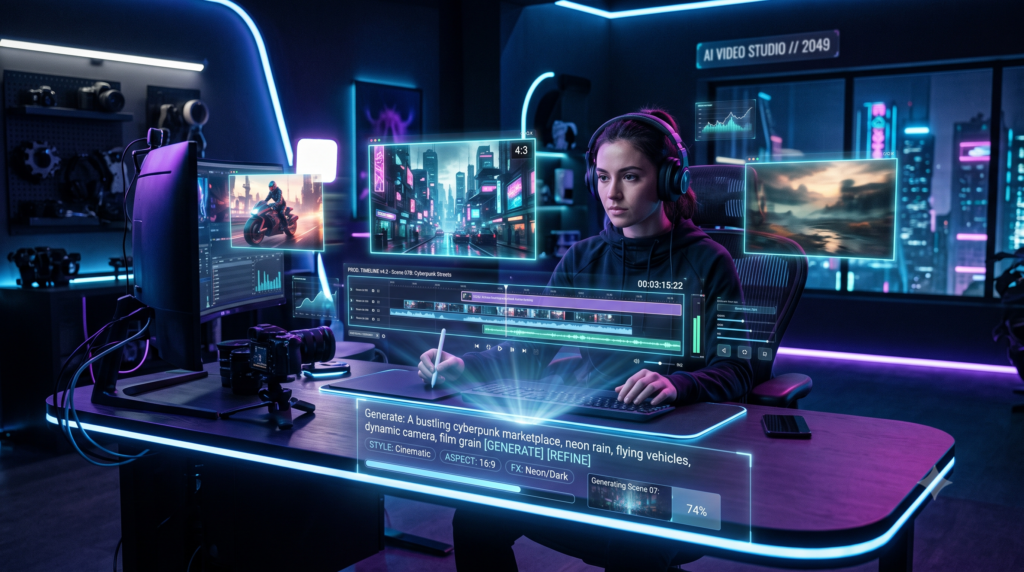
AI Video Generators: The Future of Content Creation in 2026
Creating a high-quality video traditionally required cameras, lighting, microphones, actors, editors, and hours of post-production. Today, AI video generators are changing that process. With artificial intelligence, creators can turn text prompts, images, scripts, and ideas into videos much faster than before.
In 2026, AI video creation has become more than an experimental technology. Businesses, marketers, educators, filmmakers, and social media creators are increasingly using AI video tools as part of their content workflows. Recent industry reports show that AI video is being used for marketing campaigns, training, social content, product launches, and other real-world applications.
But does this mean traditional video production will disappear? Not necessarily. Instead, AI is changing how videos are planned, created, edited, and distributed.
What Are AI Video Generators?
AI video generators are software tools that use artificial intelligence to create or modify videos. Depending on the platform, users can provide a text description, image, script, or existing video, and the AI can generate visual scenes, animations, characters, voiceovers, or other video elements.
One of the most popular technologies is text-to-video AI, where users describe the desired scene using natural language. The AI then generates a video based on that description.
For example, a creator could describe a cinematic city scene, a product advertisement, or an educational animation and use an AI video generator to create an initial version.
Modern systems have also improved in areas such as motion control, visual consistency, video editing, and audio synchronization. Research published in 2026 highlights rapid advances in video generation, including improved motion and object control and AI-based video synthesis and editing.
How Does AI Video Creation Work?
AI video creation generally begins with an input such as a prompt, image, script, or reference video.
The AI model analyzes the input and generates visual content according to the requested instructions. More advanced systems can also understand camera movements, objects, characters, environments, and different visual styles.
Text-to-Video AI
Text-to-video technology allows users to describe a scene using words.
For example:
“A futuristic city at sunset with flying vehicles and people walking through a busy street.”
The AI interprets the description and creates a corresponding video sequence.
Image-to-Video Generation
Another popular feature is image-to-video generation. Users can provide an image and ask AI to animate it.
This can be useful for turning product images, illustrations, photographs, or other visual assets into short video clips.
AI Video Editing
AI is also changing traditional video editing. Instead of manually performing every editing task, creators can use AI-assisted tools to remove unwanted sections, generate captions, improve audio, create effects, and organize footage.
This means AI is becoming part of the complete video production workflow rather than simply being a video generator.
Why Are AI Video Generators Becoming Popular?
One of the biggest reasons for the growth of AI video tools is speed.
Traditional video production can require significant planning and resources. AI can reduce the time needed for certain stages of production, allowing creators to experiment with more ideas.
For businesses, this can be especially useful for producing social media content, advertisements, product demonstrations, and training videos.
A 2026 Adobe report found that 85% of surveyed Indian creators who use creative AI described it as integrated or essential to their workflow, while 52% said AI helps them produce content faster and at a higher quality than without it.
AI Video Generators for Social Media
Social media platforms have created enormous demand for short-form video content.
Creators need fresh videos for platforms such as YouTube, Instagram, and other social networks. AI video creation can help with parts of this process, including:
- Generating visual concepts
- Creating short video clips
- Producing captions
- Developing scripts
- Creating background visuals
- Editing existing footage
- Generating different versions of content
AI is also increasingly being incorporated directly into creator workflows. For example, Instagram introduced an AI-powered creative assistant in its Edits app to help creators with ideas, hooks, captions, scripts, and content optimization.
AI Video Content for Businesses
Businesses can use AI-generated videos for several purposes.
A company might create a product demonstration without organizing a complete physical shoot. A training department could create instructional videos from written material. Marketing teams can experiment with multiple advertisement concepts before investing in a full production.
This makes AI video particularly useful for organizations that need to produce content regularly.
AI Video Generators in Education
Education is another area where AI video creation can be valuable.
Teachers and educational content creators can use AI to transform complicated concepts into visual explanations. Instead of relying only on text or static images, lessons can include animations, simulations, and narrated visual content.
For example, a science lesson could use AI-generated animations to explain a complex process. A history lesson could use visual reconstructions to make a topic more engaging.
However, educational content should still be reviewed by humans. AI-generated videos can contain inaccurate information, so factual verification remains important.
AI Video Generation in Marketing
Video has become an important part of digital marketing, and AI is making video production more accessible.
Marketing teams can use AI video tools to create:
- Product advertisements
- Social media campaigns
- Promotional videos
- Explainer videos
- Personalized content
- Product demonstrations
- Training materials
The growing market has also resulted in specialized AI video platforms. Current 2026 comparisons show that different tools increasingly focus on different areas, including cinematic generation, AI avatars, advertising, editing, and social media content.
What Are the Benefits of AI Video Creation?
Faster Production
AI can automate parts of the production process, helping creators develop video concepts and initial footage more quickly.
Lower Production Barriers
People who do not have professional filmmaking equipment or advanced editing skills can experiment with video production.
More Creative Experiments
Creators can quickly test different visual concepts, styles, scenes, and storytelling approaches.
Easy Content Repurposing
A single idea can potentially be transformed into multiple formats, such as short videos, advertisements, educational clips, and social media content.
Personalized Content
AI can make it easier to create different versions of content for different audiences, languages, or campaigns.
What Are the Limitations of AI Video Generators?
Despite rapid improvements, AI video generation is not perfect.
AI-generated content can still have problems with consistency, realistic movement, complex interactions, and precise control. Longer or more complicated projects may require multiple generations and substantial human editing.
Another important issue is originality. When everyone has access to similar AI tools, simply generating visually impressive footage may not be enough to attract an audience.
A 2026 Adobe creator survey found that as AI makes content production easier, creators increasingly see their individual voice, taste, and point of view as important differentiators.
Copyright and Content Ownership
Creators also need to think carefully about the rights associated with AI-generated content.
Before using AI-generated visuals, voices, characters, music, or other assets commercially, creators should understand the relevant platform terms, licensing conditions, and applicable laws.
Human Creativity Still Matters
AI can generate content, but it does not automatically understand a creator’s goals, audience, emotions, or brand identity.
Human creativity remains important for storytelling, strategy, fact-checking, editing, and making final creative decisions.
How AI and Humans Can Work Together
The future of AI video creation is unlikely to be simply “AI versus humans.”
A more realistic model is collaboration.
A creator can develop the idea and story, use AI to generate initial visuals, refine the output through editing, and then add human judgment and creativity.
This workflow allows AI to handle repetitive or time-consuming tasks while humans focus on storytelling and creative direction.
The Future of AI Video Generators
AI video technology is likely to continue developing rapidly.
Future AI video tools may provide better character consistency, improved physical realism, stronger control over camera movements, more advanced editing, and better integration between video, audio, and other creative tools.
The industry is already moving toward workflows where generation, planning, editing, and enhancement are combined. For example, newly launched AI video platforms are attempting to handle multiple stages of production within a single workflow.
Will AI Replace Video Creators?
AI may automate some repetitive video-production tasks, but replacing creative professionals completely is a much bigger challenge.
A successful video requires more than generating attractive images. It needs an idea, story, audience understanding, pacing, emotional connection, and creative judgment.
AI can assist with many of these processes, but human direction remains valuable.
The Key Skill Will Be Creative Direction
As AI makes video production easier, the ability to decide what should be created may become more important than simply knowing how to create it.
Creators who understand storytelling, branding, audience psychology, editing, and AI tools may have an advantage in the evolving content industry.
Conclusion: AI Video Creation Is Changing Content
AI video generators are transforming how videos are created in 2026. From social media clips and advertisements to education, training, and professional production, AI is making video creation faster and more accessible.
However, AI is not a complete replacement for human creativity. The strongest results are likely to come from combining artificial intelligence with human storytelling, judgment, originality, and creative direction.
The future of video may therefore not be completely AI-generated. Instead, it may be AI-assisted, where technology handles more of the production work while humans remain responsible for the ideas and creative vision.